
Water Treatment Basics – Contaminants
Microbiological Contaminants
| Microbe Type | Example | Disease Examples | Approx Size |
| VIRUSES | Hepatitis, Coronavirus, Poliovirus | Hepatitis A, SARS, Polio | 0.005 Micron |
| BACTERIA | E. coli, Salmonella, Shigella | Diarrhea, Dysentery, Typhoid, Cholera | 0.5 – 2.0 Micron |
| CYSTS | Cryptosporidium, Giardia | Beaver Fever | 2 – 4 Micron |
| PARASITES | Tapeworm, Ascaris | GI Infection, Guinea Worm Disease | 35 – 75 mm (eggs) |
LEAD
- Lead does not occur naturally in water.
- Homes built before 1986 frequently feature lead service pipes, fixtures and lead-based solder.
- Over time, water and chloramines corrode lead plumbing, causing traces of lead to leach into drinking water.
- Higher levels of lead can cause delayed physical and mental development in children, spikes in blood pressure, & increased risk of kidney problems.
VOC (Volatile Organic Compounds)
- VOCs are chemicals derived from fuels, solvents, polishes, cosmetics, dry cleaning solutions etc.
- They get released through ground spills or improper disposals (such as dumping in toilets), eventually migrating to water sources.
- Most VOCs are potential or known carcinogens.
Trihalomethanes (THM)
- TriHaloMethanes
- A chemical byproduct formed when chlorine reacts with naturally occurring organic compounds in water.
- Chloroform is one of the most prevalent compounds in this group.
- Like VOCs, THMs are also potential carcinogens.
Turbidity
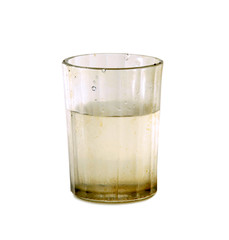
- Turbidity is the degree of cloudiness in water.
- Sand, mud, fine silt, rust, and minute microscopic particles, all contribute to turbidity.
- It does not usually have any direct health hazard, but can harbour pathogenic microorganisms.
- The degree of turbidity is measured in “Nephelometric Turbidity Units” (NTU).
- Drinking water should have turbidity less than 1.0 NTU.
Chlorine
- The most common problem in municipally treated water, but not considered a direct health risk.
- Many people are allergic to chlorine.
- It imparts an unpleasant taste and odour that alters the flavour of drinking water and brewed beverages.
Hardness (Hard Water)
- It is a very common problem in well waters with limestone/marble.
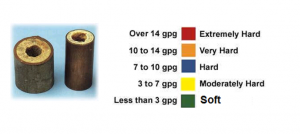
- Hard water forms a whitish scale deposit.
- It reduces the ability of soaps and detergents to lather easily.
- It is measured in Grains Per Gallon (GPG) or PPM. (1 GPG = 17.1 PPM).
IRON
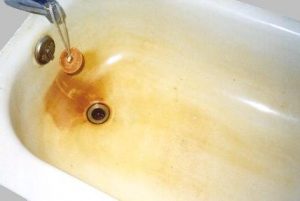
- It is typically found in well water as dissolved “ferrous iron,” which oxidizes into visible “ferric iron” (rust) upon contact with air.
- Over 0.3 PPM (mg/L) iron causes reddish brown staining of plumbing fixtures, clothes, etc.
- It also gives water an unpleasant metallic taste.
Manganese
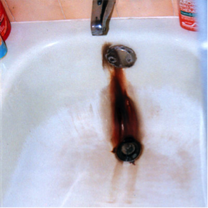
- Similar to iron, it exists in groundwater in a dissolved state until exposure to air triggers oxidation.
- Manganese levels greater than 0.05 PPM (mg/L) cause black deposits on fixtures and clothing.
- Health Canada has established an aesthetic objective of 0.02 PPM (mg/L).
- Manganese is typically accompanied by Iron.
Hydrogen Sulphide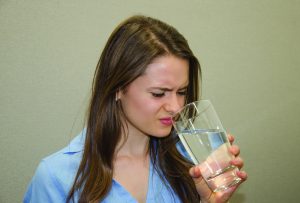
- Even in trace concentrations, hydrogen sulfide gas imparts a distinct, highly offensive “rotten egg” odour to water.
- It usually accompanies iron &/or manganese in well waters.
- It is corrosive, tarnishing silver almost instantaneously.
Tannins
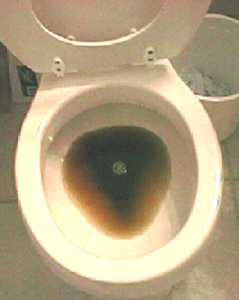
- Tannins are organics that are produced by decomposition of vegetation.
- It imparts a faintly yellowish or brown colour to water.
- While not a direct health hazard, these contaminants render water aesthetically unpleasant and significantly reduce the efficacy of disinfection systems like ultraviolet (UV) sterilizers.